
Polyester Polyol Supplier Audit: Portfolio and Delivery
A polyester polyol supplier's grade list is the cheapest audit instrument a buyer has, and the one most often misread. Read correctly, the structure of a portfolio shows where a manufacturer has done real formulation work: which application families it groups grades into, how many grades it keeps inside each family, and whether the same parameter conventions repeat across the whole range. Read carelessly, forty product codes look like forty capabilities.
This guide sets out an audit method for buyers working from evaluation into execution. It uses the six application series of Hengshui Xinfa Polyurethane Materials Co., Ltd. (XINFA) — a Chinese manufacturer of polyester polyol and polyurethane materials operating a 25,000 m² plant in the Salt Chemical Circular Economy Park, Jizhou City, with a stated polyester polyol capacity of 50,000 tons per year — as a worked example of what a readable portfolio contains. It then turns to the delivery side: capacity, lead time, minimum order, packing, acceptance testing and the trading entity behind the export documents. It closes with a scored checklist you can carry into a supplier meeting.
What a portfolio actually has to prove
A buyer comparing three quotations usually holds one technical data sheet per supplier and a price per ton. That is not enough to judge production capability, because a data sheet describes a grade, not a factory, and a catalogue describes a range, not a process. The useful question is narrower: does this portfolio look like the output of a producer that formulates for defined PU systems, or like a list assembled for quotation purposes?
Four properties separate a verifiable portfolio from a long one:
- Grouping. Grades are organised by formulation family — flame-retardant foam, pentane-blown systems, water-blown systems, adhesives, coatings — rather than listed alphabetically or by code number.
- Density. Each family holds more than one grade, so the family can be tuned for a different machine, density or reactivity target without leaving it.
- Convention. Units, tolerances and test temperatures repeat across models, so two grades can be compared without conversion guesswork.
- Coverage. Certification scope and documented project references match the grades actually offered.
None of these four properties proves performance. They establish whether a supplier deserves a sample trial, and they generate the specific questions that make that trial worth running. That distinction is what keeps a portfolio audit honest: it is a qualification filter, not a performance verdict.
Why the structure of a polyester polyol range carries information
Polyester polyols are built for a surprising number of jobs. They appear in rigid PU and PIR insulation foams, in sandwich panel and laminating adhesives, in coatings, sealants and elastomers, and in coating agents for controlled-release fertilizer. Formulators distinguish grades mainly through hydroxyl value, acid value, moisture content, viscosity and functionality, because those parameters set reactivity, the mixing ratio with isocyanate, storage behaviour and, ultimately, whether a foam cell stays closed or a bond holds.
Backbone chemistry adds a second layer. Aromatic polyester polyols, often built on phthalic anhydride or comparable aromatic streams, are widely used in rigid foam work; aliphatic types are generally chosen where hydrolytic stability and flexibility matter more. Different blowing agents and different application methods push the polyol in different directions again, which is why a serious manufacturer rarely sells "one polyester polyol". It sells a family of grades organised around an application.
Breadth has a cost. Every retained grade consumes a formulation record, a written specification, a quality-control method and, in practice, scheduled production. A maker presenting six coherent families has made six sets of those decisions. That cost structure is the inference the audit is built on — and it stays an inference until the specifications and batch records are in front of you.
Reading the six XINFA series
XINFA publishes its polyester polyol range as six named application series. Read as a set, they cover rigid insulation foam, blowing-agent-specific systems, mining work, adhesive applications and a non-foam coating application — a spread that is difficult to assemble without formulation experience in each area. The certification records for the same products list these grades together with a further group (XF-3152, XF-2412, XF-1752 and XF-2002), which is itself worth noting: a buyer should always check whether the certificate scope and the sales catalogue describe the same product set.
| Series | Published grades | What the grouping signals | What to verify before ordering |
|---|---|---|---|
| High Flame Retardant | XF-2007, XF-240P, XF-235P, XF-250P | Four grades inside one flame-retardant family — room to reformulate against a flame or foam target without leaving the series. | Which grade is recommended for your foam density, and which flame-retardant package the recommendation assumes. |
| Pentane System | XF-435, XF-390, XF-360, XF-2402N, XF-2020 | Five grades for pentane-blown systems, the family where blowing-agent compatibility and reactivity must be tuned together. | Two adjacent grade sheets side by side; the grade used with your pentane level and machine type. |
| Mining | KXF-350, KXF-280 | A separate KXF prefix for mining: the portfolio distinguishes mining formulations from construction insulation instead of relabelling one product for both. | What distinguishes the two grades, and which mining application each was developed for. |
| High Water-based | XF-2003, XF-2006, XF-3153, XF-315G, XF-300W | Five grades for water-blown systems — the widest tuning range in the range, and the family used in spraying work where reactivity and water tolerance interact. | Which grade suits your spray equipment and site temperature band. |
| Adhesive | XF-Z, XF-280 | A two-grade family: narrow and application-specific rather than a reformulation platform. | Which substrates and open times the two grades were developed for. |
| Controlled-release Fertilizer Coating | XF-270, XF-B-3, XF-B-4 | Three grades for a coating agent — the clearest evidence that the range was not built around insulation alone. | XF-270 is published with a hydroxyl value of 260 ± 10 mgKOH/g and a viscosity of 3,000 ± 500 CPS at 25 °C; request the equivalent data for B-3 and B-4. |
The distribution of grades across these families is informative. Two families carry five grades each — pentane-blown and water-blown systems — which corresponds to the applications XINFA states for its output: pipeline insulation, panels, household appliances, exterior wall insulation and cold storage. Those are precisely the areas where blowing-agent choice and machine type force a supplier to offer a tuning range rather than a single product. The two-grade families (mining, adhesive) point the other way: enough choice to fit a defined process, not enough to support broad reformulation.
Naming discipline matters more than it looks. The consistent XF- and KXF- prefixes with numeric suffixes let a buyer request, compare and approve grades without renegotiating terminology on each order. The digits themselves do not publish a chemistry, and no buyer should infer one from them. What can be audited is the consistency: a catalogue that renames equivalents from page to page is harder to qualify, because every comparison has to restart.
Parameter discipline: the signal hidden in the numbers
The second reading is not of the grades but of the numbers attached to them. A grade list becomes a comparable portfolio only when each specification line carries a nominal value, a tolerance, a unit, a test temperature and, ideally, a method reference.
The published specification for XF-270 shows the shape a usable line takes: hydroxyl value 260 ± 10 mgKOH/g, viscosity 3,000 ± 500 CPS at 25 °C. A buyer can act on that. The tolerance defines the acceptance band, and the temperature defines the condition under which the viscosity figure means anything.
Moisture and acid value are the two limits that most often decide whether a delivered drum behaves like the approved sample. The audit question is not whether the number is low — it is whether the convention is consistent across the series you intend to buy. If one grade sheet states a moisture maximum of 0.1% and its neighbour states 0.15%, the difference is not automatically a defect; it may be justified by the grade or by the test method. But the justification should come from the supplier, in writing, rather than from your own assumption. The same test applies to acid value: a ceiling published for one grade and omitted for the grade beside it leaves an incomplete picture, however favourable the published figure looks.
Watch for silent unit changes as well. CPS versus mPa·s, viscosity at 25 °C versus 40 °C, hydroxyl value expressed in different conventions — a portfolio that mixes these without labelling cannot be compared grade to grade, and an incomparable portfolio can only be trialled, never audited.
Does the certificate scope cover the portfolio you are buying?
The third reading is the certificate, and the question is specific: does the scope description name the products in your offer, and do the numbers hold up when checked?
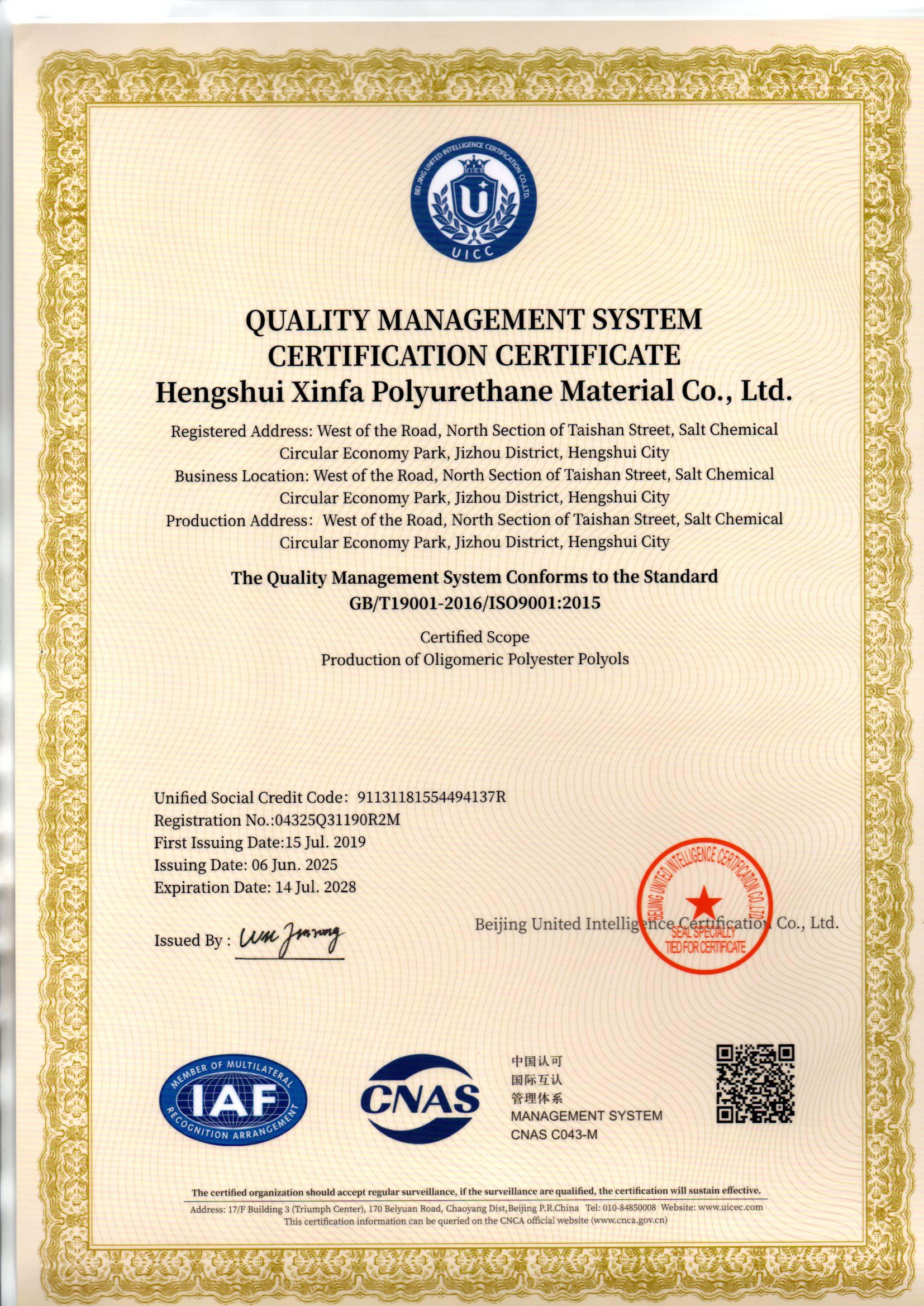
XINFA holds three management-system certifications issued by Beijing United Intelligence Certification Co., Ltd.:
- ISO 9001:2015 (GB/T 19001-2016), certificate 04322Q31390R1S, issued 6 June 2025 and valid to 14 July 2028, scope "Production of Oligomeric Polyester Polyols".
- ISO 14001:2015 (GB/T 24001-2016), certificate 04326E01332R101, valid from 15 June 2026 to 14 June 2029, scope covering the production of oligomeric polyester polyols and related management activities.
- ISO 45001:2018 (GB/T 45001-2020), certificate 04326S01211R101, valid from 15 June 2026 to 14 June 2029, with the same scope wording.
Two audit observations follow. First, the scope says production, not trading — which matters when the commercial offer arrives through a separate export company, because the certificate belongs to the manufacturing entity. Second, the certification records enumerate the product groups in scope, and that enumeration is the cross-check: match it against the series you intend to buy, and ask about any grade that appears in the catalogue but not in the scope list.
Boundary condition. ISO 9001 certifies a quality management system for production; it is not product approval for your market. Whether a given polyester polyol grade satisfies building insulation rules, agricultural coating requirements or any other downstream regulation is a separate question that you must resolve for your own jurisdiction, with your own compliance file.
Delivery signals: capacity, terms and the entity behind the documents
Capability documents describe what a plant can do; delivery signals describe what happens between purchase order and arrival. Both belong in the same audit, because a formulation range that cannot be scheduled is not a supply option.
Capacity read as a ratio, not a headline
XINFA states an annual polyester polyol capacity of 50,000 tons, built on more than 30 sets of intelligent equipment across the 25,000 m² site, with more than 60 employees including 13 management and research staff. The capability statement separately lists a monthly production capacity of 4,000 metric tons. Read these against your own order size rather than in isolation: a stated minimum order quantity of 1 metric ton inside a 4,000-ton-per-month operation means qualification lots can be scheduled, but it says nothing about how quickly a custom grade moves through the queue.
Lead time and quality control
The stated lead time is 15–20 days, with 100% testing and pre-shipment test as the acceptance criterion. Three questions sharpen that: does the 15–20 days start at purchase order or at approved formulation; does it include the pre-shipment test; and is the pre-shipment test run on the production batch or on a composite sample? The answers determine whether the quoted window survives a custom grade.
Packing and commercial terms
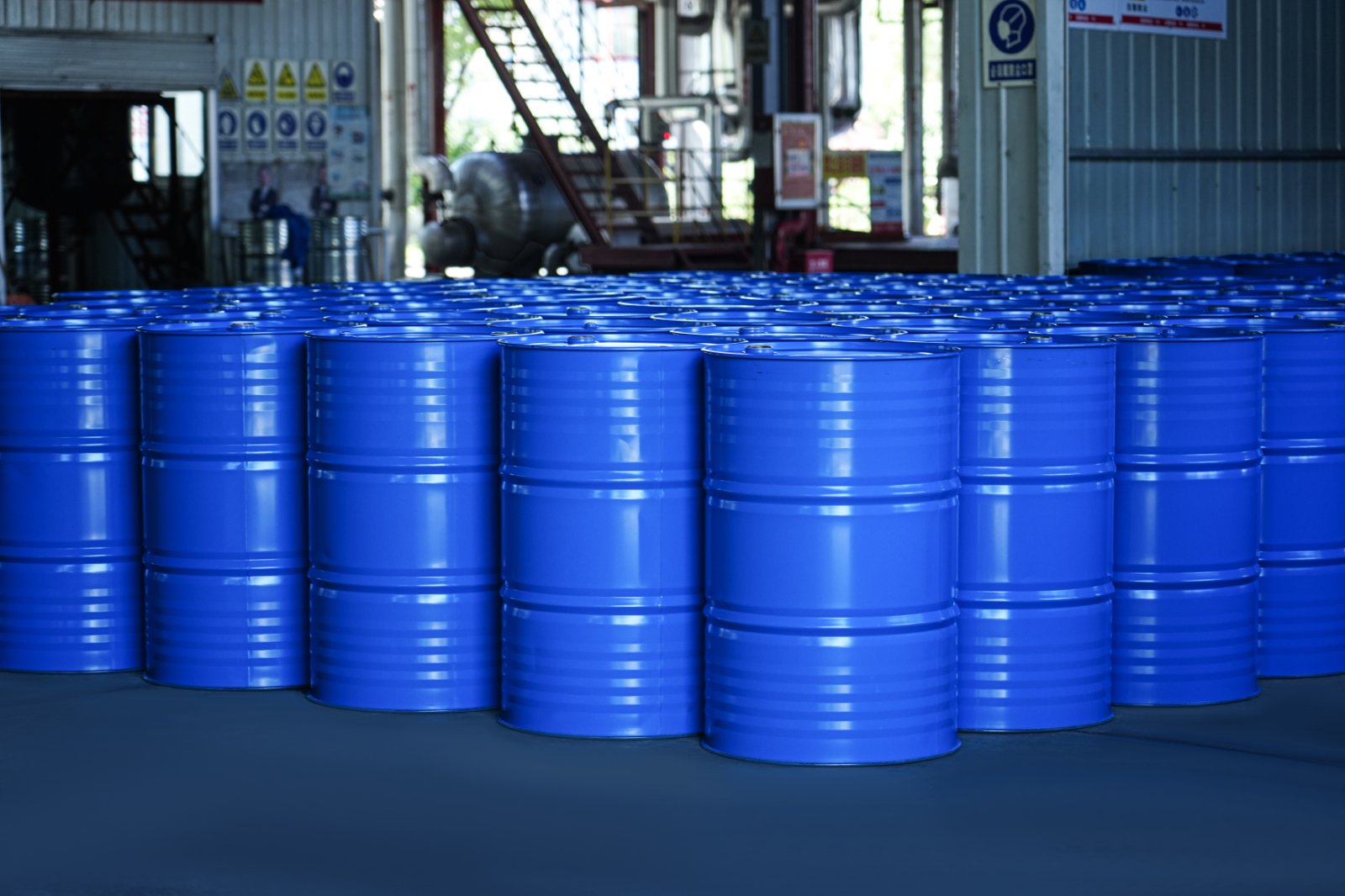
Packing is offered as 1,200 kg and 1,000 kg IBCs, or galvanized iron drums of 225 kg, 200 kg and 170 kg. Packaging choice is not cosmetic: IBC versus drum changes unloading equipment, residue and moisture exposure during storage. Commercial terms are FOB or CIF, with T/T and L/C payment, and the purchasing documentation describes the minimum order quantity as customer-requested while the capability statement lists 1 metric ton for OEM and ODM production — a discrepancy worth settling in writing before the quotation is signed.
The export entity
XINFA operates through a wholly-owned subsidiary, Hebei Xinshe Technology Co., Ltd., based in Shijiazhuang, which handles the import and export of polyurethane materials, catalysts and related products alongside the parent company's production. The company describes this as combined domestic manufacturing and global trade. Its stated export ratio is about 10% of output, with listed markets spanning the Middle East, India, Pakistan, Southeast Asia, Central Asia, Europe, North America and South America. For a first order, establish which entity contracts, which entity invoices, which entity supplies the certificate of analysis, and where the pre-shipment test is performed. After-sales support is listed as technical support and product training; confirm who delivers it and in which language.
Adjacent products as a coherence check
The same manufacturer supplies amine catalysts and flame retardants, including TEDA (triethylenediamine, CAS 280-57-9), TEDA A33, PC-5, PC-8, PC-9, PC-15, PC-41, BDMA, BDMAEE, DMDEE, DMAEE, TMR-2, DMP-30, A-1, T-9, plus TCPP and TEP. For a systems formulator this is a genuine convenience: polyol and catalyst can be matched by one technical contact instead of two. It is also an audit point — clarify whether each item is produced or traded, since the certificate scope covers polyester polyols, not the whole catalogue.

Where the portfolio stays silent
A portfolio audit has a hard boundary, and naming it protects the buyer from over-reading a good catalogue.
- Batch-to-batch variance is not visible in a grade list; only certificates of analysis across several batches show it.
- Capacity utilisation is not published, so a 4,000-ton monthly figure cannot tell you how much of it is already committed.
- Catalogue versus routine production is unclear: a listed grade may run weekly or only on request.
- Price and total cost sit outside the technical documents entirely, and a broad portfolio is not automatically a cheaper one.
- Fit with your process cannot be inferred from a family name; it has to be trialled on your equipment.
Two documented references and what they establish
Project references are the part of a portfolio most often quoted and least often examined. Two documented cases show how to read them.
Poland, spraying foam, 500 metric tons over two years. The project used a grade from the High Water-based series (product record 3943: XF-2003, XF-2006, XF-3153, XF-315G, XF-300W) and is documented as running stably across wall spraying, insulation boards, soundproof flooring, leak-proof pipelines and composite materials. The stated material properties are high mechanical strength, high wear resistance, resistance to high and low temperature cycling, hydrolysis resistance and ageing resistance. Read as evidence, this shows a water-blown family sustaining a multi-year spray operation — and it invites the follow-up questions: which grade, which machine, which acceptance data.
India, pipeline insulation, 100 metric tons over two years. The project used a grade from the Pentane System series (product record 3941: XF-435, XF-390, XF-360, XF-2402N, XF-2020) and is documented with high strength and density, thermal conductivity performance, fire retardancy and structural support for pipelines.
Both references share the same limitation, and it should be stated plainly: they document that a supplier's grade ran in another customer's process for two years. They do not predict performance in yours, where substrate, machine, ambient conditions and blowing agent may all differ. Their value is that they convert a claim into a set of specific questions.

Questions buyers ask before a first order
Which certifications cover XINFA's polyester polyol production, and what do they not cover?
Three management-system certificates cover production of oligomeric polyester polyols: ISO 9001:2015 (certificate 04322Q31390R1S, issued 6 June 2025, valid to 14 July 2028), ISO 14001:2015 (04326E01332R101, valid 15 June 2026 to 14 June 2029) and ISO 45001:2018 (04326S01211R101, same validity period), all issued by Beijing United Intelligence Certification Co., Ltd. They certify management systems for production. They do not certify that a given grade meets your market's building, agricultural or transport requirements, which remains a separate compliance check on your side.
Does XINFA offer OEM and ODM production for custom polyester polyol grades?
Yes. The company lists OEM and ODM production services with customisation scoped to polyester polyol, a minimum order quantity of 1 metric ton in its capability statement, 100% testing and a stated lead time of 15–20 days, together with technical support and product training after delivery. Because the purchasing documentation describes the minimum order quantity as customer-requested, confirm the applicable figure and the customisation boundary for your specific grade in writing.
What are the purchasing terms and acceptance criteria?
Delivery terms are FOB or CIF, payment is by T/T or L/C, and acceptance is based on a pre-shipment test. Packing options are 1,200 kg and 1,000 kg IBCs or galvanized iron drums of 225 kg, 200 kg and 170 kg. Ask for the parameters included in the pre-shipment test and for a certificate of analysis against the grade specification before the order is released.
How should a buyer validate a grade before committing to a full batch?
Start with two technical data sheets from the same series and compare them line by line: nominal value, tolerance, unit, test temperature and whether each limit is a maximum or a range. Then trial the grade on your own equipment against the declared window, and use the supplier's technical support during the trial rather than after it. The pre-shipment test then becomes the repeat of that trial, not the first measurement.
What lead time and capacity should a buyer plan around?
The stated lead time is 15–20 days against a monthly production capacity of 4,000 metric tons and an annual polyester polyol capacity of 50,000 tons. Confirm two things in the meeting: whether the lead time applies to a custom grade as well as a catalogue grade, and whether it includes the pre-shipment test. For a first order, the practical next step is to request the grade data you need, compare it with a sample, and then ask for a quotation — the product brochure is available for download at the XINFA brochure PDF.
A scored checklist for the supplier meeting
Score each point as you would in an internal qualification file: 0 when nothing is provided, 1 when it is only claimed verbally, 2 when it is documented but inconsistent, 3 when it is documented and holds across the whole range you intend to buy. Score what you can evidence, not what you remember from the meeting. Any 0 or 1 becomes a written question rather than an automatic rejection, because most gaps are answered by a document request.
| Audit point | Evidence to request | Score 0–3 |
|---|---|---|
| Series architecture is grouped by application family | Full grade list with an application column per series | 0 / 1 / 2 / 3 |
| At least two grades exist in the family you intend to use | Technical data sheets for two adjacent grades | 0 / 1 / 2 / 3 |
| Each spec line carries nominal value, tolerance and unit | Complete data sheet set, not a summary page | 0 / 1 / 2 / 3 |
| Moisture ceiling stated for every grade in the series | Data sheet plus certificate of analysis from a recent batch | 0 / 1 / 2 / 3 |
| Acid value ceiling stated and consistently applied | Data sheets compared side by side | 0 / 1 / 2 / 3 |
| Viscosity quoted with test temperature | Data sheet detail, including whether the value is a range or a maximum | 0 / 1 / 2 / 3 |
| Certificate scope names the products being offered | Certificates plus the grade list in scope | 0 / 1 / 2 / 3 |
| Capacity, MOQ and lead time are stated as figures | Capability statement and formal quotation | 0 / 1 / 2 / 3 |
| Packing formats and acceptance test defined before PO | Commercial offer with the pre-shipment test parameters | 0 / 1 / 2 / 3 |
| Contracting entity and export documentation path are clear | Trade documents naming the manufacturer and the export company | 0 / 1 / 2 / 3 |
| Technical support and training named as deliverables | After-sales terms in the agreement | 0 / 1 / 2 / 3 |
Conclusion: audit the structure, then verify the batch
A polyester polyol portfolio is worth reading before any sample is shipped, because its structure records decisions a reseller does not have to make: how many application families to maintain, how many grades each family needs, and which parameter conventions to hold across the range. XINFA's six series show what that looks like in practice — five-grade tuning ranges in pentane-blown and water-blown systems, narrower two-grade families for mining and adhesives, and a coating family for controlled-release fertilizer that sits outside insulation entirely.
The portfolio alone decides nothing. Pair it with the delivery side — 50,000 tons per year of stated capacity, a 4,000-ton monthly figure, 15–20 days lead time, 1 metric ton minimum order, defined packing and a pre-shipment acceptance test — and with the certification scope that names the products rather than the catalogue. Then verify with two data sheets, one trial and one batch certificate. That sequence converts a long grade list into a qualification decision you can defend internally.
Next step. Take the checklist into your evaluation, then request the grade data and a sample for the series that matches your process. Company brochure: download the PDF. Technical enquiries: Jessica, admin@xinfapu.com, tel +86 156-3365-7995.
Have Questions or Need More Details?
Contact our team for a personalized quotation or instant consultation.
Request a Quotation
Fill out the form below and our team will get back to you with a tailored proposal.
WhatsApp Direct Chat
Prefer to chat in real-time? Message us on WhatsApp for instant assistance & quick answers.
- Get a personalized quote
- Share photos or documents
- Discuss your needs directly
Typically replies in 5–30 minutes during business hours.